
 Sales :
 Email :

Summarize this article using AI
Refreshed on October 16, 2026
Summary
Manual invoice validation leaves most carrier charges unchecked, which allows overcharges, missed discounts, and duplicate fees to reach payment. This article explains how manual review affects operations, finance, procurement, and audit teams, the signs that your invoice volume has outgrown spot checks, how rate audit software validates every line against your contracts, and how Rate Audit Results in Parcel Spend Intelligence catches errors before invoices are approved.
Key takeaways
- Manual spot checks cover only a fraction of carrier charges, so errors your team never reviews get paid at face value.
- The cost is beyond accounts payable: procurement cannot confirm negotiated discounts, operations works from incomplete data, and audit teams lack the records they need.
- Rate audit software checks every invoice line against your contracts and flags discrepancies before payment, so the terms you negotiate are the terms you pay.
- Once invoice volume outpaces your team's review time, automation becomes the practical way to keep up.
Manual invoice validation usually means spot-checking a handful of charges and hoping nothing major slips through. The process is slow, exhausting, and error-prone, and invoices arrive faster than anyone can review them. To keep payments moving, most companies accept carrier charges at face value. Billing errors are common, and when small mistakes are repeated across thousands of shipments, they add up to real losses.
How does manual invoice validation affect each team?
The cost of manual invoice audits shows up differently in every department that reaches a carrier bill:
- Operations and logistics leaders need a clear picture of what drives shipping costs, but they end up working from incomplete or inaccurate data. An inconsistent audit process makes it hard to spot trends or improve contracts.
- Finance and accounts payable teams spend hours every week processing carrier bills. Pressure to close the books quickly keeps reviews partial, and the team approves invoices with hidden overcharges inside them.
- Procurement managers negotiate hard for discounts and incentives, then have no way to prove that carriers honor those terms. A missed discount rarely surfaces in a manual review.
- Internal auditors and compliance teams struggle to pull together evidence of contract compliance and financial accuracy. Without structured records, external audits become harder and more stressful.
On top of the hours it consumes, manual review weakens compliance, undercuts your position in carrier negotiations, and lets recoverable money go unclaimed.
Is manual invoice validation ever enough?
Manual invoice validation can work for a small business with a handful of shipments each week. For companies shipping at scale, it becomes a costly gamble. Accounts payable departments already struggle to keep pace with invoices of every kind: Ardent Partners' State of ePayables research found that they take an average of 8.2 days to process an invoice and handle 18.4% of invoices as exceptions. Carrier invoices add another layer, with surcharges, discounts, and accessorial fees to check on every shipment. The volume of data and the limits of human review make it impossible to catch every mistake, and a team working through a 90-page invoice with a spreadsheet will miss errors no matter how careful it is.
When should you move from manual to automated invoice audits?
Several signs show that manual validation has stopped working for your business:
- Invoice volume is too high for your team to review in a reasonable time.
- Finance staff spend days each month checking spreadsheets instead of closing the books.
- Your team discovers overcharges and duplicate fees only after you pay the invoices.
- Procurement cannot confirm that carriers apply your discounts consistently.
- Audit and compliance groups struggle to prepare documentation for reviews.
If any of these sound familiar, your invoice volume has outgrown manual review.
How does rate audit software validate carrier invoices?
Rate audit software removes the bottleneck by checking every invoice line against your carrier contracts, including base rates, surcharges, discounts, and accessorial fees. It flags duplicate charges, misapplied discounts, and incorrect surcharges as invoices arrive. It also stores your agreements in one place, so every team works from the same terms, and it creates exportable audit trails for internal and external reviews, which strengthens compliance, control, and cost recovery across your carrier contracts. Analytics and dashboards built on that data show where errors occur and where savings opportunities exist, which gives procurement firmer ground in carrier negotiations and supports better forecasting.
Here is how the two approaches compare:
Manual invoice validation vs. automated rate audits
|
Area |
Manual Validation |
Automated Rate Audits |
|
Coverage |
A sample of charges on selected invoices |
Every line on every invoice |
|
Timing |
Errors surface after payment, if at all |
Discrepancies flagged before approval |
|
Discount enforcement |
No reliable way to confirm terms were applied |
Every charge checked against negotiated terms |
|
Contract records |
Agreements scattered across files and inboxes |
One central repository for every agreement |
|
Audit documentation |
Assembled by hand for each review |
Structured, exportable audit trails |
|
Staff time |
Days each month spent in spreadsheets |
Hours returned to closing the books |
When every team can trust the numbers on a carrier invoice, finance, procurement, and audit can make financial decisions with confidence.
What does Rate Audit Results add to Parcel Spend Intelligence?
We built Rate Audit Results directly into Parcel Spend Intelligence because carrier invoices are too complex to trust to spot checks. It brings automated invoice validation into the same platform you use to understand and manage parcel shipping costs, so contract checks and cost insight work from the same data.
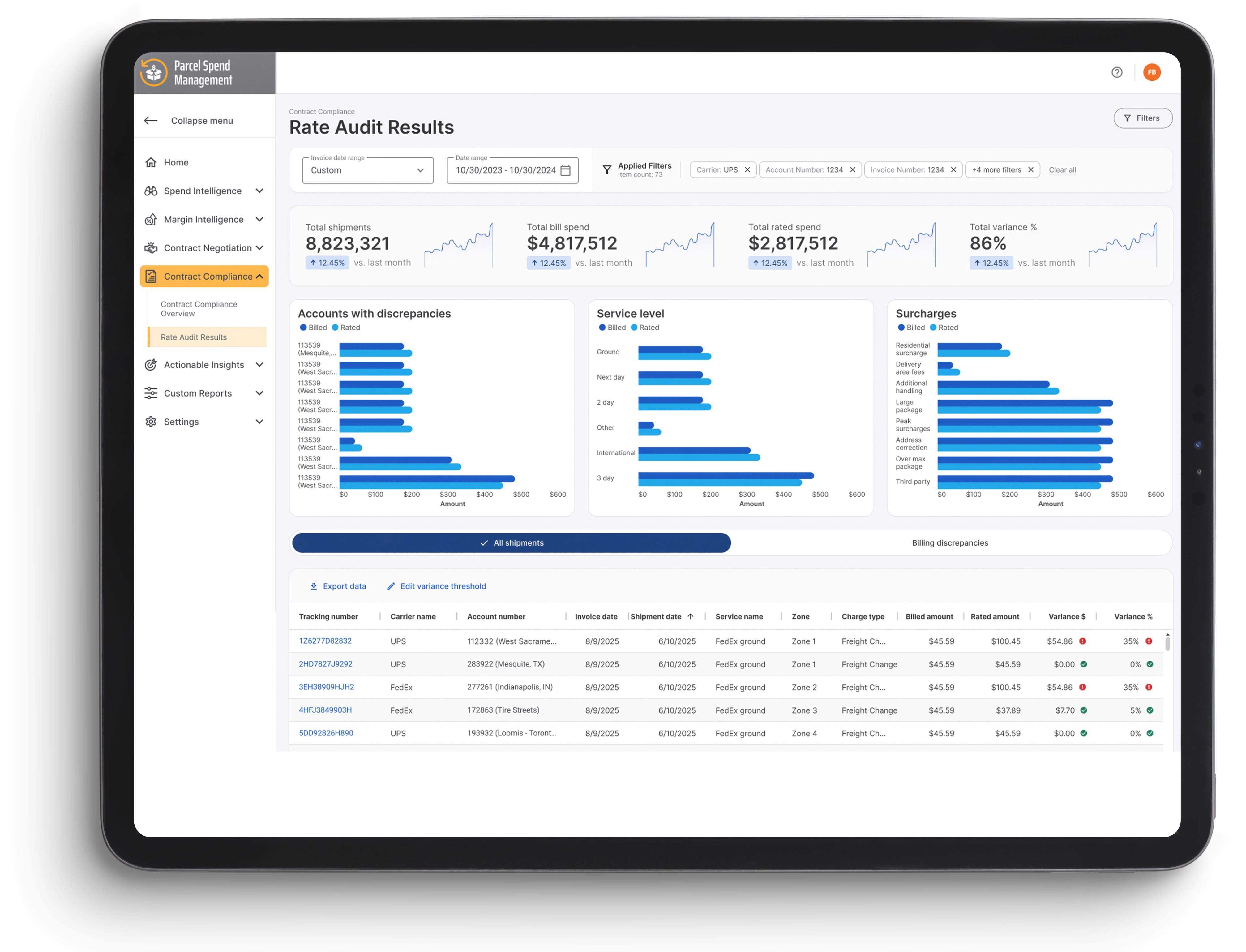
With Rate Audit Results, you get:
- Every contract in one place: a central record of your carrier agreements that serves as a single source of truth.
- Line-by-line invoice validation: every charge checked against your negotiated terms.
- Discrepancies flagged before payment: overbilling caught before you approve an invoice.
- Audit-ready records: compliance and reporting data structured for finance, procurement, and audit teams.
Carriers adjust surcharges and terms throughout the year, and each change creates new room for billing errors that manual checks will miss. Our team at TransImpact can show you what those errors are costing your business and how Rate Audit Results in Parcel Spend Intelligence catches them before you approve payment. Request a call with our parcel team to get started.
FAQs
What is manual invoice validation?
Manual invoice validation is the process of reviewing carrier invoices by hand to confirm that charges match your contracted rates. Most teams can only spot-check a sample of charges, so they pay most line items as billed.
What errors does rate audit software catch?
Rate audit software checks base rates, surcharges, discounts, and accessorial fees against your contracts. It flags duplicate charges, misapplied discounts, and incorrect surcharges before you approve payment.
Does automated rate auditing help with compliance?
Yes. Automated audits create structured, exportable records of every invoice check, which gives internal auditors and compliance teams the documentation they need for internal and external reviews.
How does Rate Audit Results work with Parcel Spend Intelligence?
Rate Audit Results is built into Parcel Spend Intelligence. It stores your carrier agreements in one place, validates every invoice line against your negotiated terms, and flags discrepancies before you approve payment.