Skip to content

You Paid For Perfect Delivery. Your Carriers Didn’t Deliver.

Stop Leaking Margin.

Start Paying Only What You Actually Owe.

Most shippers overpay by 3-7% on every freight invoice - not because rates are wrong, but because errors hide in plain sight. Duplicate charges. Misapplied accessorials. Out-of-contract fees. Our AI-powered freight audit catches what manual reviews miss, automatically validating every invoice against your contracts before payment is released. 

With Dozens of Carriers, How Do You Know What's Accurate?

Most businesses overpay 3-7% on freight, not because rates are wrong, but because errors hide in plain sight.


Every carrier bills differently. Different accessorial schedules, contract terms, and invoice formats. When you're managing dozens of carriers across multiple modes, no one is validating every invoice charge ed before payment runs. The volume makes it impossible. So duplicate charges slip through. Accessorials get applied that weren't agreed to. Fuel surcharges get calculated on outdated rates.

Fragmentation is why these errors never get caught.  

freight-transportation-sunset-with-trucks-airplane
Product Sale-2

30 days to measurable savings

Cost of Goods Sold-3

100% spend visibility

Icon savings-1

Automatically     recover 3-7% 

Net Margin-2

80-85% reduction in processing costs

AI-Powered Freight Audit That Finds What Manual Reviews Miss

logistics-means-transport-together-with-technological-futuristic-holograms (6)
Icon freight overpaying-1
Stop Overpaying on Freight 
 
  • Billing errors and invalid charges get caught before they get paid
  • Know exactly what you're paying and why 
  • Every dollar you recover goes straight back to your bottom line
 
Icon freight manual audits

Hold Every Carrier Accountable on Every Invoice

  • Charges are validated against contracted rates and the services performed
  • When a carrier bills incorrectly, you have the documentation to prove it 
 
 Icon freight pay ontime

Pay Carriers Accurately, On Time, Every Time

  • Validated invoices mean payments are clean, dispute-free, and on time
  • Carrier relationships stay strong and late fees stay off your bill

Icon freight intelligence 

One Place to Audit Every Carrier, Every Mode

  • Full visibility across every lane, mode, carrier, and customer in one place
  • No fragmented systems, no data silos, no blind spots in your transportation spend


Pay Every Carrier From a Single Approval

Once your invoices are validated, every carrier gets paid accurately from a single approval on your end. No payment to manage. No carriers to chase. No reconciliation lag. 

 One Payment Across Every Carrier 

 Approve a single consolidated payment and every carrier is paid individually, no matter how many carriers, modes, or contract terms you're managing. 

 Every Invoice Validated Before Funds Move 

 No dollar leaves until it's been checked against your contracts. Billing errors caught in audit never make it to payment. 

 GL Coding and Reconciliation, Done for You 

 Every invoice is coded to your GL structure before the payment report is generated. Matched invoices close automatically. Exceptions get flagged, not buried. 

Bring Control and Certainty to Freight Spend

Higher Profit
Freight Invoice Audit
Validate every invoice against contracted rates, accessorial rules, and shipment details to identify errors before payment.
Smarter Decisions, Faster.-1
Automated Payment Processing
Streamline freight bill payment with automated workflows that ensure accuracy, timeliness, and proper approvals.
Proven Margin Growth
Multi-Mode Support
Audit and manage invoices across all transportation modes including parcel, LTL, FTL, ocean, air, and intermodal.
Single Source of Truth
Claims Support
Capture the right data to support claims and disputes, improving recovery rates, and reducing time spent gathering information.
Know Your Best Customers & Products-1
Spend Visibility and Reporting
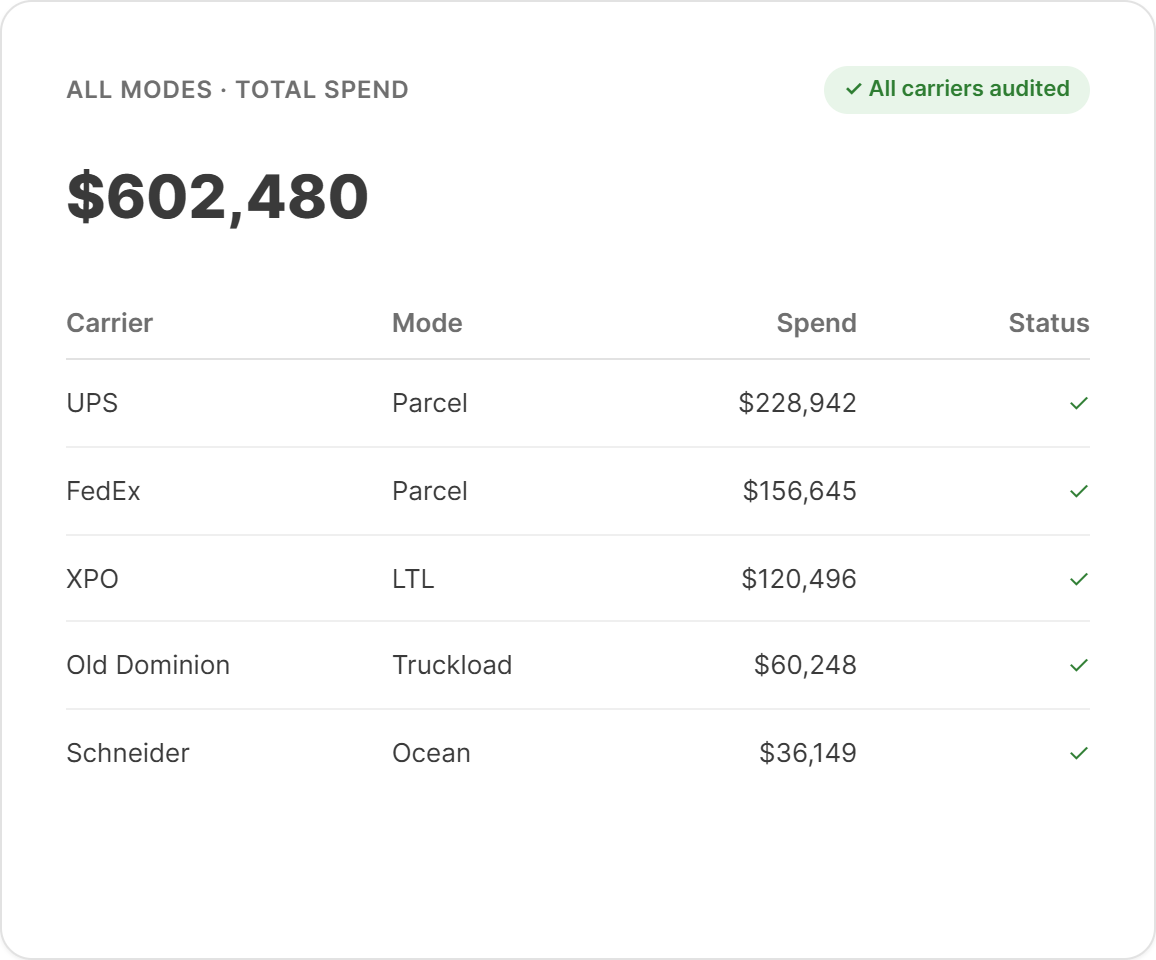
Access dashboards and reporting that show total spend, cost drivers, trends, and areas of risk or opportunity.
Stop Hidden Costs.-1
Duplicate and Error Detection
Prevent duplicate payments and catch incorrect charges such as rate discrepancies, invalid fees, and billing inconsistencies.

Frequently Asked Questions

Freight audit and payment is the process of validating carrier invoices for accuracy before payment is released. It matters because billing errors are everywhere - duplicate charges, incorrect fuel surcharges, misapplied accessorials, and out-of-contract rates hide in nearly every invoice. Without systematic auditing, these errors get paid, and most shippers overpay by 3-7% of their total freight spend. A robust freight audit and payment solution catches these mistakes before payment, protects margin, and gives you complete visibility into where transportation dollars actually go.

Manual review catches obvious errors - wrong weight, obviously duplicated invoices, clearly incorrect rates. But freight invoices contain hundreds of line items across multiple carriers, each with complex contract terms and accessorial schedules. Manual processes miss the subtle errors: fuel surcharges calculated on last month's rates, accessorials that violate negotiated caps, duplicate invoices with slightly different reference numbers, and pattern-based billing issues that only appear across multiple shipments. AI-powered freight audit analyzes every invoice against your contracted rates and historical patterns, identifying over 150 error types that manual review consistently overlooks - and does it in minutes, not days.

Freight audit identifies a wide range of errors including: incorrect base rates that don't match your contract; duplicate invoices (even when invoice numbers differ slightly); fuel surcharges calculated on outdated indexes or applied to incorrect shipment weights; accessorial charges that exceed negotiated caps or don't align with service performed; residential delivery fees applied to commercial addresses; detention and waiting time charges that contradict delivery records; dimensional weight miscalculations; incorrect freight class assignments; and unauthorized charges for services you didn't request or receive. Many of these errors are difficult to spot manually because they require cross-referencing contract terms, shipment data, and historical billing patterns across thousands of transactions.

Most shippers recover between 3-7% of their total freight spend through audit-driven error detection and correction. Beyond direct error recovery, automated freight audit and payment reduces invoice processing costs by up to 80-85% by eliminating manual review, accelerating payment cycles, and reducing disputes. The bigger strategic value comes from the intelligence freight audit provides: visibility into carrier performance, cost trends by lane and mode, and verified execution data that strengthens your position in contract negotiations. This intelligence often leads to 10-20% additional savings in subsequent carrier contracts.

Both. Pre-payment auditing validates every invoice against your contracted rates and shipment data before payment is approved, preventing errors from being paid in the first place. This is where the majority of value comes from - catching mistakes before they drain margin. Post-payment auditing reviews historical invoices to identify patterns, recover missed savings retroactively, and provide insights for contract optimization. The dual approach ensures maximum cost recovery and compliance while building the data foundation for smarter procurement decisions.

When an error is identified, it depends on whether it's pre-payment or post-payment. For pre-payment errors, the invoice is automatically flagged and routed to the appropriate stakeholder with clear documentation of the discrepancy, supporting contract terms, and recommended resolution. Payment is held until the error is corrected. For post-payment errors, the platform automatically generates claims and routes them through the carrier dispute process. Experienced freight audit providers manage the entire dispute lifecycle - submitting documentation, following up with carriers, and tracking recovery through resolution - maximizing recovery rates while freeing your team from dispute management.

Yes. Once your invoices are audited and validated, you approve a single consolidated payment and every carrier is paid individually from that one approval. Every invoice is ingested, normalized, and checked against your contracts before any funds move. Each invoice is also coded to your GL structure before the payment report is generated, so your finance team gets a clean feed with no manual coding. Matched invoices close automatically. Exceptions get flagged for review, so nothing slips through and nothing sits in a queue waiting on your team. 

Accurate, on-time payments actually strengthen carrier relationships. When invoices are thoroughly validated before payment, carriers receive correct payment faster - without back-and-forth disputes, delayed payments, or contentious recovery processes. This improves your shipper-of-choice status and can lead to better service priority. Additionally, when disputes do arise, freight audit provides clear documentation of contract terms, shipment details, and billing discrepancies - making resolution faster and less adversarial. Carriers appreciate working with shippers who have their billing processes under control.

AI and machine learning analyze patterns across millions of freight transactions to identify anomalies that rule-based audits and manual reviews consistently miss. Machine learning models recognize subtle billing discrepancies - like fuel surcharges calculated on outdated rates, accessorials that violate negotiated caps when combined across multiple shipments, or duplicate invoices with altered reference numbers. The system learns from every correction, improving accuracy over time. AI also enables predictive freight accruals, automated GL code mapping based on shipment attributes, and conversational analytics that let you query your freight spend data in natural language to uncover hidden cost drivers.

You'll need carrier invoices (which can be received electronically via EDI, API, email, or carrier portals), your negotiated carrier contracts and rate agreements, and shipment data from your TMS, ERP, or warehouse management system (including BOLs, purchase orders, and delivery records). Most freight audit platforms integrate directly with major ERP systems (SAP, Oracle, Manhattan) and TMS platforms via API, EDI, or SFTP so data flows automatically without manual file transfers. The platform normalizes data from different sources and formats into a unified structure for validation and analysis.

Most freight audit and payment implementations are completed in 4-6 weeks, with clients seeing measurable savings within the first 30 days. The process typically involves connecting to your carrier billing systems and existing ERP/TMS platforms; loading your carrier contracts and rate tables into the audit engine; configuring business rules and approval workflows; and running historical invoice audits to establish a baseline. Modern platforms are designed to minimize IT burden - integration happens through standard APIs, EDI, and SFTP connections that don't require custom development.

Absolutely. While enterprise shippers with massive freight volumes see significant dollar savings, small and mid-size companies often see even higher percentage recoveries because they lack the staff and systems to catch billing errors manually. Freight audit and payment solutions are typically priced on transaction volume or as a percentage of freight spend, making them accessible and scalable for businesses of any size. Even companies shipping 50-100 loads per month can achieve meaningful ROI through error recovery, reduced processing costs, and better visibility into transportation spend.

Yes, we maintain enterprise-grade security standards including SOC 2 Type 2 certification, GDPR compliance, and regular third-party security audits. Your transportation and financial data is encrypted in transit and at rest, with role-based access controls, audit trails of all system activity, and secure data exchange protocols (API, EDI, SFTP with encryption). These security measures protect sensitive rate information, shipment details, and payment data throughout the audit and payment lifecycle.

TransImpact offers a complimentary freight spend analysis. We'll review a sample of your recent invoices to identify existing billing errors and quantify potential savings. This no-obligation assessment typically reveals 3-7% in recoverable overpayments and gives you a clear picture of ROI before committing. From there, implementation takes 4-6 weeks, and you start seeing recovered funds and cost savings within the first 30 days.

Parcel Margin Analysis Q & A

What is Parcel Margin Analysis (PMA)?

Parcel Margin Analysis is a business analytics tool that provides critical sales and profitability analysis inclusive of actual parcel shipping costs. PMA answers a critical and difficult question for companies that use it: How much am I really making on my products inclusive of parcel shipping costs?

Why should I use PMA?

Companies are faced with difficult pricing decisions trying to recover costs for shipping. Do you include shipping for “Free” and absorb the cost? Do you charge a flat rate for shipping? Do you estimate and then charge your cost or with a slight mark up? There is no single right answer, but there can be many wrong ways. No matter how you decide to deal with shipping costs, they can erode margin, especially when underestimated. PMA provides the necessary insight to quickly assess the impact your shipping decisions are having on margin.

How does PMA work?

We work with your team to routinely access your sales and cost of goods and bring them into a data model to reveal your sales margin. Using your actual parcel shipping costs from our Parcel Spend Intelligence solution in combination with your sales data, PMA clearly exposes the impact parcel shipping costs are having on your margin. The analysis is delivered how you measure it, whether that’s by customer, individual product, sale, or SKU.

Can you get the same results by doing a spot check analysis or using your “gut feel”? Why chance it when PMA provides the insight on a weekly basis so that you can see exactly what is going on and make data-informed decisions.

What data does PMA use?

Through various integration options, PMA can automatically gather sales order data, cost of goods, fees, and parcel transportation costs to provide profitability insights on your customer, the order, and the products fulfilled. Our team works with your IT team to optimize the connection to internal data, and we leverage our Parcel Spend Management platform to automatically gather actual parcel shipping costs directly from the parcel carrier’s billing center.

Is PMA hard to use?

We will begin in this chapter by dealing with some general quantum mechanical ideas. Some of the statements will be quite precise, others only partially precise. It will be hard to tell you as we go along which is which, but by the time you have finished the rest of the book, you will understand in looking back which parts hold up and which parts were only explained roughly.