
 Sales :
 Email :

Summarize this article using AI
Summary
Rate audit software checks every parcel carrier invoice against your contract terms and flags overcharges before they are paid. This article explains why manual and outsourced audits fall short, how automated rate audits serve finance, procurement, and audit teams, and how TransImpact Rate Audit Results brings this validation into Parcel Spend Intelligence.
Key takeaways
- Manual spreadsheet checks, outsourced audits, and paying invoices at face value all allow overcharges to go undetected and weaken your position in carrier negotiations.
- Rate audit software validates every invoice line against your contracted rates, surcharges, and discounts, so errors surface before your team approves payment.
- Every flagged discrepancy gives procurement documented evidence of missed discounts to bring into the next carrier negotiation.
Revised: October 5, 2026
Shipping is one of the highest and least controlled costs at most companies. Parcel invoices are dense, inconsistent, and full of charges that are hard to trace to a contract, and manual checks are too slow and error-prone to keep up with the volume. When overcharges get through, finance approves invoices that include them, procurement has no way to confirm that carriers applied your negotiated discounts, and audit teams have no compliance trail to point to. Week after week, money leaves your business without anyone noticing.
Why do manual parcel audit processes fail to scale?
Billing mistakes are a symptom of a larger gap: most companies have no centralized, scalable way to check carrier charges against their contracts. Without that foundation, finance cannot stop overpayments before they happen, procurement cannot enforce the terms it negotiated, and audit teams cannot prove compliance.
Most teams fall back on one of three approaches, and each one carries a cost:
- Manual validation in spreadsheets takes hours of staff time, invites errors, and breaks down as shipment volume grows.
- Outsourced audits add fees, slow down recovery, and leave your team with little insight into what the auditor checked.
- Paying invoices at face value lets every overcharge through and gives up the evidence you need in your next carrier negotiation.
Each approach leaves blind spots that weaken your negotiating position and erode margins over time.
What is rate audit software?
Rate audit software automatically checks every carrier invoice against the terms of your shipping contracts. It confirms that base rates, surcharges, and discounts match what you negotiated and flags any overcharges or errors it finds. Rate audit software also stores all of your carrier contracts in one place, validates charges line by line, and produces audit-ready reports. The outcome for your finance, procurement, and audit teams is fewer overpayments, more recovered dollars, a stronger negotiating position, and a clear compliance trail.
What happens when carrier billing errors go undetected?
A high-volume retailer believed its carrier billing was under control, and for eight months its invoices appeared correct. Then, in a single week, the carrier overbilled the company by $360,000.
By the time the retailer identified the problem, $1.2 million had already left its account. The carrier opened an investigation only after the retailer provided specific examples, and that investigation uncovered a systemic misconfiguration in the carrier's billing.
Without rate audit software, errors like this one can run for months before anyone notices. Automated rate audits validate every line item against your contract, catch problems as soon as they appear on an invoice, and document each discrepancy so your disputes move quickly.
How does rate audit software protect your budget and contracts?
Rate audit software protects your margins in four ways.
- Catch errors before they drain your budget. Rate audit software validates every line item against your carrier contract, and flags overcharges as soon as they appear. Finance gets accurate invoices, accounts payable stops overpayments before they go out, and procurement keeps every negotiated discount.
- Keep every carrier contract in one place. A secure, centralized contract repository gives procurement the terms it needs to enforce agreements, gives finance a reference for validating charges before payment, and gives audit teams structured records that support compliance requirements.
- Strengthen negotiations with data. Discrepancy records give procurement documented proof of every discount a carrier failed to apply, which turns your next negotiation into a discussion of facts and builds your case for better rates.
- Recover savings sooner. Automated audits begin flagging overcharges as soon as your contracts are in the system, so finance can protect the budget within the current quarter.
Which rate audit features support compliance and cost recovery?
The features below turn rate audit software into a compliance and cost recovery tool for finance, procurement, and audit teams.
|
What it does |
Why you need it |
|
Line-item invoice validation |
Matches invoices to contracted rates across carriers to prevent overpayment |
|
Centralized contract repository |
Stores and manages all carrier agreements securely in one place |
|
Contract loading powered by artificial intelligence |
Reduces manual entry by 1 to 2 hours per contract and speeds setup |
|
Automatic discrepancy and overcharge flags |
Highlights billing errors above your dollar or percentage thresholds |
|
Dispute reporting and claim support |
Provides the data and workflows to resolve carrier disputes faster |
|
Exportable audit trails and reports |
Creates structured records for finance, procurement, and audit compliance |
|
Shipment-level detail |
Shows finance and accounts payable the variances by package, lane, or account |
How does rate audit strengthen your carrier management strategy?
Even the best carrier agreements can fail in execution when you have no scalable way to validate invoices against contracted rates. Rate audit software closes that gap by turning your carrier contracts into enforceable, auditable controls.
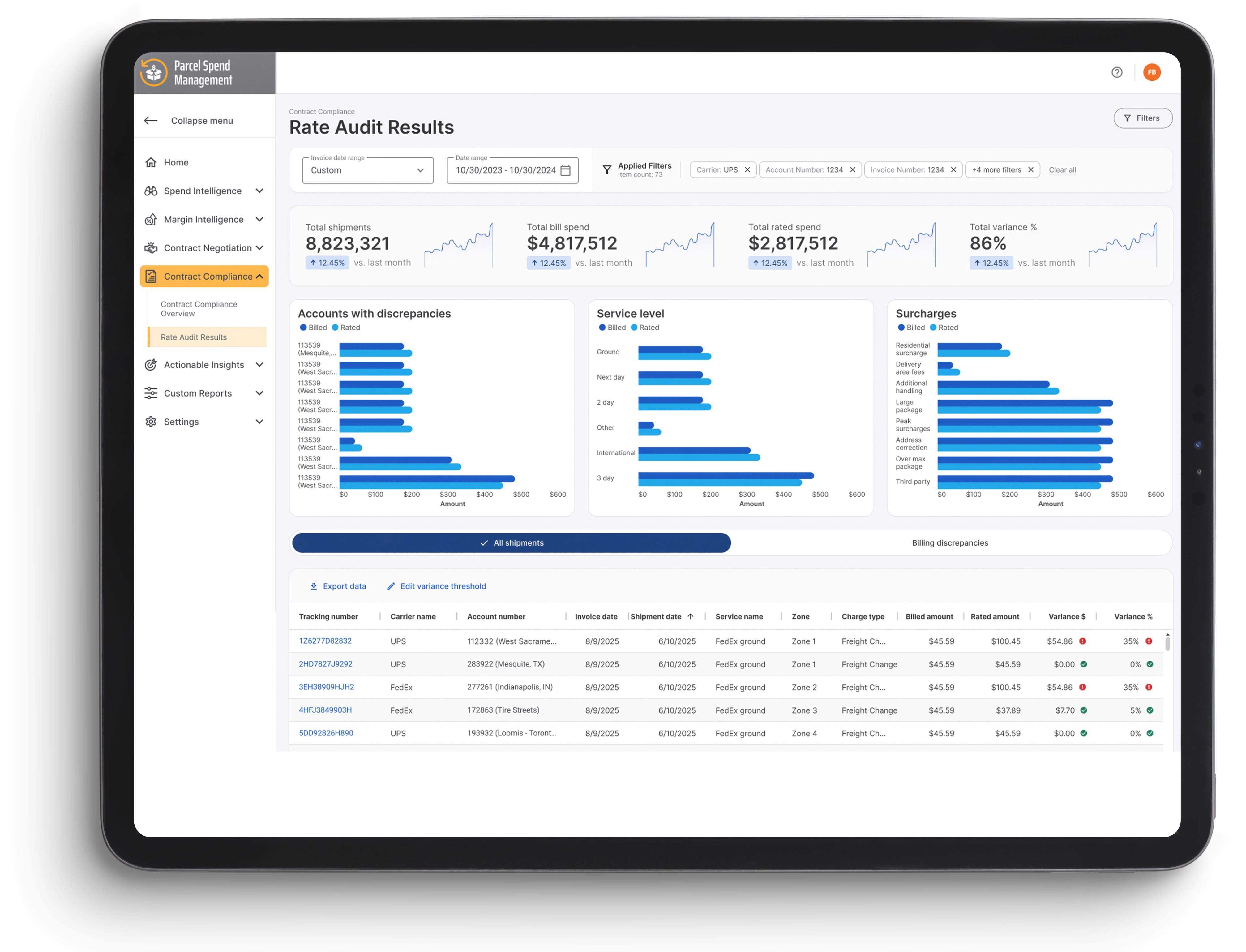
TransImpact Rate Audit Results brings this level of control into Parcel Spend Intelligence. It validates every shipment line against your carrier contracts and keeps those agreements in one place, so your teams can confirm rate accuracy with real data. For organizations ready to move from reactive audits to proactive carrier management, TransImpact Rate Audit Results offers a practical, scalable way to protect margins and enforce contract compliance every day.
Find out whether your carriers are billing you what your contracts say. Talk with a TransImpact parcel expert about putting automated rate audits to work for your business.
FAQs
What does rate audit software check on a parcel invoice?
Rate audit software compares each line of a carrier invoice with the terms in your shipping contract, confirming that base rates, surcharges, and discounts match what you negotiated. Charges that exceed your set dollar or percentage thresholds are flagged for review and dispute.
How is automated rate auditing different from outsourcing parcel audits?
Outsourced audits add cost, slow recovery, and often leave your team unable to see what was checked. Automated rate auditing runs on every invoice inside your own system, so finance, procurement, and audit teams work from the same records.
How does rate audit data help in carrier negotiations?
Each flagged discrepancy is a documented record of a contract term the carrier did not honor. Procurement can present that evidence in the next negotiation to show where discounts went unapplied and press for better rates.
How does TransImpact Rate Audit Results work with Parcel Spend Intelligence?
TransImpact Rate Audit Results validates every shipment line in Parcel Spend Intelligence against your carrier contracts and stores those agreements in one place. AI-powered contract loading reduces manual entry by 1 to 2 hours per contract, so your team starts validating invoices sooner.