
 Sales :
  Email :
Summarize this article using AI
AI is already delivering measurable value across the supply chain, and its results are clearer than most people realize. At the 2026 Gartner Supply Chain Symposium | XPO, TransImpact's Vice President of Product Management, Lori Gipp, took the podium with practical news about using AI for a variety of improvements.
Her session, From Buzzword to Blueprint: AI in the Modern Supply Chain, focused on what AI actually does right now in the supply chain, its biggest opportunities, and how you can put it to work in your operation step by step. Lori organized the talk around four areas: the hype, the reality, the obstacles, and the way forward.
Key Takeaways
- A 15% improvement in demand forecast accuracy can deliver a 2% to 3% gain to your bottom line; AI-powered forecasting paired with sales team input can lift accuracy by another 10% to 20%.
- Safety stock optimization can reduce inventory carrying costs by 10% to 20% and can move risk decisions from individual planners to the leadership level.
- AI delivers measurable results today across five functional areas: demand forecasting, inventory management, supplier management, warehouse operations, and logistics and transportation.
- Data quality is the single biggest factor in AI project success - and roughly 80% of supply chain data still goes unused.
- The winning approach is evolution, not revolution - pick one well-defined problem, solve it, and use that win to fund the next step.
What Won't AI Do for the Supply Chain Yet?
Before walking through what AI delivers, Lori cleared the air on a few promises that don't hold up under scrutiny. The most persistent promise is the dream of the fully autonomous, lights-out supply chain that runs itself without human involvement. Closely related is the idea that AI can be plugged into existing systems and immediately produce useful insights with no data preparation required - a tempting story, but one that ignores what most operational data looks like. There's also the recurring concern that AI is about to replace planners, analysts, and decision-makers, along with the allure of digital twins so comprehensive that they attempt to mirror entire networks at extraordinary cost.
None of these is entirely fictional, but each one is overstated enough to derail honest conversations about what AI can do for your business today.
How Supply Chain plans to use or not use AI and Gen AI over the next 2 years 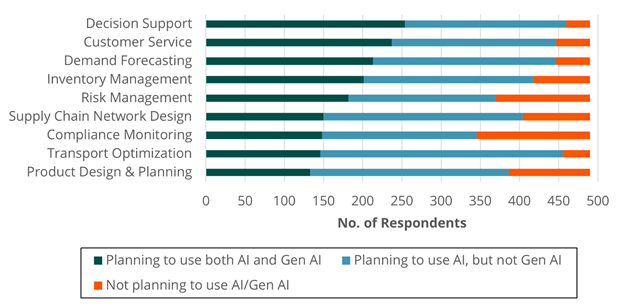
Source: ABI Research, 2025 Supply Chain Survey Results—Artificial Intelligence (AI) Usage and Investment Plans
That said, the appeal for AI is real. Citing ABI Research, Lori shared what supply chain organizations are planning to do with AI:
- 94% plan to use it for decision support
- 90% for forecast accuracy
- 90% for customer support
- 85% for inventory management
For agentic AI specifically - autonomous systems that string multiple tasks together to reach a goal -plans for the next two years break down like this:
- 83% for supplier relationship management
- 75% for customer support
- 69% for decision-making
- 62% for bridging data across organizational silos
The intent is universal. However, the execution is where it gets harder.
What Do These AI Terms Actually Mean?
Before walking through use cases, Lori paused to clarify the vocabulary - because half the confusion in AI conversations comes from people using the same words to mean different things.
- AI is the goal: machines doing tasks that would normally require human intelligence.
- Machine learning (ML) is the method - training machines to learn from data without being explicitly programmed.
- Natural language processing (NLP) and large language models (LLMs) give machines the ability to understand and produce human language.
- Generative AI creates new content.
- Agentic AI strings these capabilities together to execute complex workflows on its own - drawing on perception, reasoning, memory, planning, and action.
Lori also broke AI value into three levels. At the first level, efficiency and optimization, AI takes routine work off your team's plate - pattern recognition, document processing, and the day-to-day tasks that machines now handle in seconds. The second level, augmentation and personalization, is where AI starts making your people sharper. It weighs consequences, surfaces recommendations, and helps you make better decisions in complex environments where the right answer isn't obvious. The third level, innovation and transformation, is where AI begins to anticipate trends, optimize whole networks at once, and enable business models that weren't possible before. Most companies operate somewhere between the first and second levels today. The ones pulling ahead are deliberately building toward the third.

Where Is AI Earning Its Keep Today?
The reality, Lori argued, is more useful than the hype. AI today works best when it augments human judgment rather than replacing it, when it surfaces predictive analytics across information that used to be in silos, and when it's pointed at specific, well-defined problems instead of the whole supply chain at once. And it always, without exception, requires good data. The biggest reason AI projects fail, she said, is poor data quality. That must be solved first.
With that foundation in place, Lori walked through five functional areas where AI is delivering measurable results right now.
1. Demand Forecasting
This is often the biggest dollar impact, and the numbers are striking. Most companies hit only 60% to 70% forecast accuracy. A 15% improvement in accuracy can deliver a 2% to 3% improvement to the bottom line. Pairing AI-powered forecasting with the forward-looking input of your sales team can lift accuracy by another 10% to 20%, producing the kind of rock-solid forecast that everything downstream depends on.
AI brings three big capabilities to demand:
- Enhanced accuracy - handling the complex SKU patterns that defeated older statistical methods
- Similarity modeling - building credible forecasts for new product launches by using patterns from comparable existing SKUs
- Demand sensing - pulling in near-real-time data so you catch shifts in buying behavior as they happen
If your forecast is shaky, every downstream decision is at risk. Lori said fixing the foundation is the priority.
2. Inventory Management
Machine learning is reshaping how you think about safety stock, and that's where some of the biggest cost reductions hide. Newer tools use dozens of variables to project safety stock requirements far more accurately, then translate those projections into dollars so you can see your exact risks. Real-time auto-replenishment ties stock levels, sales trends, lead times, and supplier performance together to drive smarter ordering. Anomaly detection finds missing items or unusual demand patterns and flags them as early warnings rather than after-the-fact discoveries.
In an interview after her session, Lori discussed why safety stock matters:
"Right now, if you don't have a safety stock optimizer, almost everybody is going to pad safety stock,” Lori said. “But what does that mean? You're spending more money on inventory. The tool allows you to bring solid information to the surface, to have a conversation at the leadership level about how much risk we're assuming, instead of a $50,000-a-year supply planner having to make that decision on their own. Because trust me, when I was that person, I'm going to pad that number. I don't want to stock out."
Industry estimates suggest safety stock optimization can reduce inventory carrying costs by 10% to 20%. This translates into real money, especially across a large inventory base.
And it's not just about strategic targets. You also need dynamic tools to handle day-to-day execution: minimum order quantities, truckload constraints, supplier disruptions, and seasonal pressure points like the Chinese New Year. Lori called this layer essential, not optional:
"On a day-to-day basis, supply planners have to optimize how that material is going to be ordered,” she said. “Minimum order quantities, truckloads, things like that can cost the organization thousands and millions. So, something that helps those people dynamically optimize orders, move things forward and backward. If you have Chinese New Year or even ad hoc disruptions, something that manages moving your orders around to avoid disruption, to bring in additional materials - all of those things go right to the bottom line, because all of those are going to optimize inventory."
3. Supplier Management
In supplier management, Lori said AI accelerates the work of discovery and vetting, generating short lists, validating certifications, and pulling unstructured media data for due diligence. Chatbots handle routine supplier inquiries about order status and payments around the clock, freeing your team for higher-value work. Scenario planning tools run simulations against alternative suppliers and recommend mitigation strategies when geopolitical or operational risks emerge.
4. Warehouse Management
In the warehouse, Lori said AI analyzes product demand, size, and turnover to design more efficient storage configurations. Machine learning optimizes warehouse layouts and picker travel paths. Meanwhile, AI-powered robotics and drones automate picking, packing, and sorting, increasing both throughput and accuracy in environments where labor availability has become a constraint.
5. Logistics and Transportation
In logistics and transportation, Lori said AI integrates SKU information, traffic, and weather data to automate the complex last-mile delivery, cutting fuel consumption and improving customer satisfaction in the same operation. It generates highly accurate ETAs by combining GPS, IoT sensor data, and weather APIs. And it scales customer service through chatbots that support human agents and, in many cases, handle entire interactions on their own.
These cases are in production today at supply chain organizations of every size. The common thread is that each one solves a specific, well-defined problem rather than trying to remake the whole supply chain in a single project.
What's Slowing AI Adoption in the Supply Chain?
If AI's value is so clear, why is adoption uneven? Lori pointed to three obstacles, and she returned to the first one repeatedly: data quality. Bad data sinks AI projects faster than any other factor. The second obstacle is fear - the worry that AI will eliminate jobs, combined with the anxiety about any new technology. The third is simpler but no less paralyzing: figuring out where to start. You can probably name a dozen places where AI might help in your operation. Pinpointing the one place to start tomorrow is the harder question, and it's where most leaders get stuck.
How Should You Get Started with AI?
The good news is that you don't have to figure this out alone, and you don't have to bet the business on a single big project. Lori laid out a sequence that mirrors how successful organizations approach AI adoption:
- Learn: Study how others have created value, understand the categories of technology available, and identify the hot spots in your industry
- Identify the right problems: Focus on the questions you can't answer today, the problems that take too long to resolve, and the information gaps affecting your margin
- Clean and connect your data: Roughly 80% of supply chain data goes unused; start with what you have, then bring in other internal data, and increasingly, external data like weather services and government statistics
- Prototype: Solve chunks of the problem, then iterate by adding one piece at a time
- Measure value at every step: Use the value generated by your first increment to fund the next one
Lori was candid about TransImpact's own journey. The company tried to boil the ocean early on and quickly learned that doesn't work. The better path is to focus on customers' biggest problem first - forecast accuracy - cleaning the relevant data, creating a training ground, and then expanding outward by adding more data and answering more questions over time. Her phrase for the approach: evolution, not revolution.
It's a useful test for any AI initiative on your roadmap. The organizations getting real results are picking a meaningful problem, solving it well, and using that win to drive the next step. That same philosophy shapes how TransImpact's Intelligent Supply Chain Planning platform is built - to solve specific problems, then expand as your data and your team's confidence grow.
Where That Leaves You
AI in your supply chain is real, the value is measurable, and the techniques to capture it exist today. What separates the organizations getting results from those still talking about getting results is clarity - about what to solve, what data you need, and what is the first useful step.
If you've been waiting for the perfect strategy, Lori made it clear: pick the problem that matters most, solve it well, and keep going.
Want to talk about where your supply chain could start? Learn more about Supply Planning or request a demo.
FAQs
How much does demand forecast accuracy affect the bottom line?
A 15% improvement in demand forecast accuracy can deliver a 2% to 3% gain to your bottom line. Most companies hit only 60% to 70% accuracy today, leaving significant value on the table. Pairing AI-powered forecasting with forward-looking input from your sales team can lift accuracy by another 10% to 20%.
How much can safety stock optimization reduce inventory costs?
Industry estimates suggest safety stock optimization can reduce inventory carrying costs by 10% to 20%. Beyond the cost savings, optimization tools elevate the conversation about acceptable risk from individual planners to the leadership level, where it belongs.
What are the biggest obstacles to AI adoption in the supply chain?
Three obstacles slow AI adoption most often: poor data quality, fear of job displacement, and uncertainty about where to start. Data quality is by far the biggest factor in whether AI projects succeed or fail, and roughly 80% of supply chain data still goes unused.
What is the best way to start with AI in your supply chain?
Start small, not big. Lori recommends a five-step sequence: learn from others, identify the right problems, clean and connect your data, prototype solutions in chunks, and measure value at every step. The guiding phrase is "evolution, not revolution."
What percentage of supply chain organizations plan to use AI?
According to ABI Research, 94% of supply chain organizations plan to use AI for decision support, 90% for forecast accuracy, 90% for customer support, and 85% for inventory management.
.jpg?width=352&name=Reduce%20Waste%20and%20Save%20on%20Carrying%20Costs%20(1).jpg)