
 Sales :
  Email :
You Paid For Perfect Delivery. Your Carriers Didn’t Deliver.
Stop Leaking Margin.
Start Paying Only What You Actually Owe.
Most shippers overpay by 3-7% on every freight invoice - not because rates are wrong, but because errors hide in plain sight. Duplicate charges. Misapplied accessorials. Out-of-contract fees. Our AI-powered freight audit catches what manual reviews miss, automatically validating every invoice against your contracts before payment is released.
Key takeaways
- Alternative carriers have matured into full operations, with their own networks, delivery technology, and distinct service tiers.
- The six here fall into different types — last-mile, regional, on-demand, national, and consolidator — and each is built for a different kind of shipping.
- The details that decide fit are coverage, service tiers and weight limits, delivery technology, and how each carrier prices and completes the final mile.
- The right choice depends on your own shipping: your package mix, distances, density, volume, and speed. Comparing options against your own data is the way to know.
An alternative carrier is any delivery company outside the largest national carriers. They include regional carriers, last-mile specialists, on-demand driver networks, and consolidators. Many are built around online retail, and over the past few years they have grown their coverage, technology, and reliability to the point where they handle serious volume. This guide compares six of them. For each, you'll find what it does, the features it offers, the kind of shipping it is built for, what makes it distinct, and one thing to keep in mind.
How do you evaluate an alternative carrier?
No two shipping operations are alike, so a carrier that saves one company money can cost another more. Before comparing names, it helps to know what to look for. Four things matter most:
- Coverage. Where does the carrier deliver, and how much of that overlaps with where your customers are? A carrier can only help you on the routes it serves well.
- Where your packages go. Carriers deliver cheaply in areas where they already run dense routes, because adding one more stop costs them very little. So how your orders are spread across the map, and how much of that overlaps with each carrier's strongest areas, has a large effect on what any given carrier can offer you.
- Price and fees. Extra charges for residential delivery, fuel, busy seasons, and hard-to-reach areas can add up to a big share of your bill. Many alternative carriers charge fewer of these, and because their rates are negotiated, they have room to compete for your business.
-
Service and tracking. A second carrier only helps if the experience holds up: reliable delivery times, clear tracking, and quick fixes when something goes wrong. Your customer shouldn't be able to tell who delivered the package.
The alternative carriers compared
1. OnTrac
Website: ontrac.com
Overview
OnTrac is a coast-to-coast carrier for online retail deliveries, running its own seven-day-a-week network across 35 states and Washington, D.C., and reaching more than 70% of the U.S. population. It describes itself as having over 65 years of experience. Alongside standard ground delivery, it is rolling out an economy tier, OnTrac Ground Essentials, for non-urgent orders at scale.
Key features
- Standard ground delivery plus Ground Essentials
- No residential surcharge and fewer surcharges on the economy tier
- Under-one-pound rates on Ground Essentials
- SMS delivery notifications and AI-validated photo proof of delivery
- API and multi-carrier software integrations
- Seven-day-a-week, weekend delivery reaching 48 of the 50 largest metros
Best suited for: brands and 3PLs shipping residential e-commerce volume at scale, including non-urgent orders where a slower economy tier fits.
What sets it apart
OnTrac offers coast-to-coast reach on a single regional network, with an economy tier that prices up to 30% below comparable economy shipping while reaching more than 75% of U.S. shoppers.
Consideration
Ground Essentials transit runs about one to two days longer than standard ground, includes limited claims coverage, and is offered at contract rates with eligibility criteria.
2. GOFO
Website: gofo.com
Overview
GOFO is a last-mile delivery carrier built for e-commerce, running its own connected network with technology at the center. It covers 47 states, more than 300 hubs and stations, and over 400 linehaul routes, reaching about 75% of the U.S. population and 96 of the 100 largest metro areas across more than 12,000 ZIP codes. GOFO offers two service tiers: GOFO Parcel for lighter, faster shipments and GOFO Ground for heavier and larger items.
Key features
- Two service tiers: GOFO Parcel (1–5 days, up to 20 lb, longest side up to 23.6 in) and GOFO Ground (2–8 days, up to 150 lb, longest side under 108 in)
- Intelligent routing that optimizes carrier selection and route for delivery performance
- Real-time, branded post-purchase tracking with unified fulfillment data
- One-collection, one-label integration across sales channels
- Returns handling, with three delivery attempts before a parcel is sent back per your business rules
- Handles general cargo and lithium-battery products; Ground also takes irregular-sized packages
Best suited for: online retailers and marketplaces sending high volumes of small-to-midsize parcels across metro markets, with a heavier or irregular Ground option when needed.
What sets it apart
GOFO reports a 99.8% successful delivery rate and 98.5% on-time performance across a network of 300-plus hubs and stations and 400-plus linehaul routes. It emphasizes licensed, compliant cross-state operations, held to labor and data-protection standards, alongside technology-driven efficiency and local support.
Consideration
The faster Parcel tier caps at 20 pounds and 23.6 inches. Heavier or larger items move to the Ground tier, which runs on a longer timeline and reaches fewer ZIP codes.
3. UniUni
Website: uniuni.com
Overview
UniUni handles the final leg of delivery for online retailers, third-party logistics providers, and marketplaces. It runs on a network of independent, on-demand drivers that scales quickly during busy periods, moving more than a million packages a day and covering about 65% of the U.S. and 80% of Canada. Its network is built around smaller e-commerce parcels.
Key features
- On-demand independent-driver network that adds capacity for peak seasons
- AI-assigned routing and real-time tracking
- Three photos captured at every drop-off as proof of delivery
- Connections into major e-commerce and marketplace platforms
- Positioned as low-cost, with no added surcharges
- Built for parcels under 10 pounds
Best suited for: high-volume online retailers and marketplaces with lightweight, metro-concentrated orders and large seasonal swings in volume.
What sets it apart
UniUni's on-demand driver model flexes capacity to match demand spikes while moving more than a million packages a day, with three-photo proof of delivery on every order.
Consideration
The network is built for parcels under 10 pounds, and its U.S. coverage is still expanding.
4. Amazon Shipping
Website: supplychain.amazon.com
Overview
In May 2026, Amazon opened its logistics network to businesses of all kinds through Amazon Supply Chain Services, extending the freight, distribution, fulfillment, and parcel operations built for its own retail business. Its parcel shipping moves orders from any sales channel nationwide, with pickup from your warehouses and tracking all the way to the customer's door.
Key features
- Two-to-five-day delivery with seven-day-a-week service, including weekends
- Pickup from your own warehouses or third-party providers
- Tracking from label creation to the doorstep, including photo-on-delivery
- Handles orders across all your sales channels
- Optional warehousing, distribution, fulfillment, and freight from the same provider
- A unified inventory pool and a single console to manage it all
Best suited for: businesses that want national delivery frequency, or a single provider spanning parcel, warehousing, fulfillment, and freight.
What sets it apart
Amazon Shipping opens the same logistics network behind Amazon's own retail business to any company, so parcel delivery can connect to warehousing, fulfillment, and freight in one place.
Consideration
Access runs through Amazon's console rather than a published rate card.
5. DoorDash
Website: doordash.com
Overview
DoorDash runs an on-demand courier network of more than 7 million drivers and puts it to work for businesses in two ways: Drive On-Demand, a white-label same-day delivery service, and Package Pickup, a doorstep collection service for returns. Both run on the same driver network behind its local delivery business.
Key features
- Drive On-Demand: same-day local delivery from your own website or app, under your own brand
- Order integration through an API or more than 1,000 platform integrations
- Live customer tracking, with a flat per-delivery fee and no subscription
- Package Pickup: a driver collects up to five prepaid packages or returns from a customer's door and drops them at a nearby carrier, with photo confirmation
- Package Pickup available to 95% of Americans
- Serves restaurants, grocery, convenience, retail, and more
Best suited for: retailers that need branded same-day local delivery, or a simple doorstep option for customer returns, running alongside their main carriers.
What sets it apart
DoorDash's 7-million-driver network powers both branded same-day local delivery and doorstep returns pickup, wired into a retailer's existing systems through its integrations.
Consideration
Both services are built for local, same-day movement, and the returns route hands packages to another carrier for the long haul, so DoorDash works as a complement to a primary shipping carrier.
6. DHL
Website: dhl.com/us-en/home/ecommerce
Overview
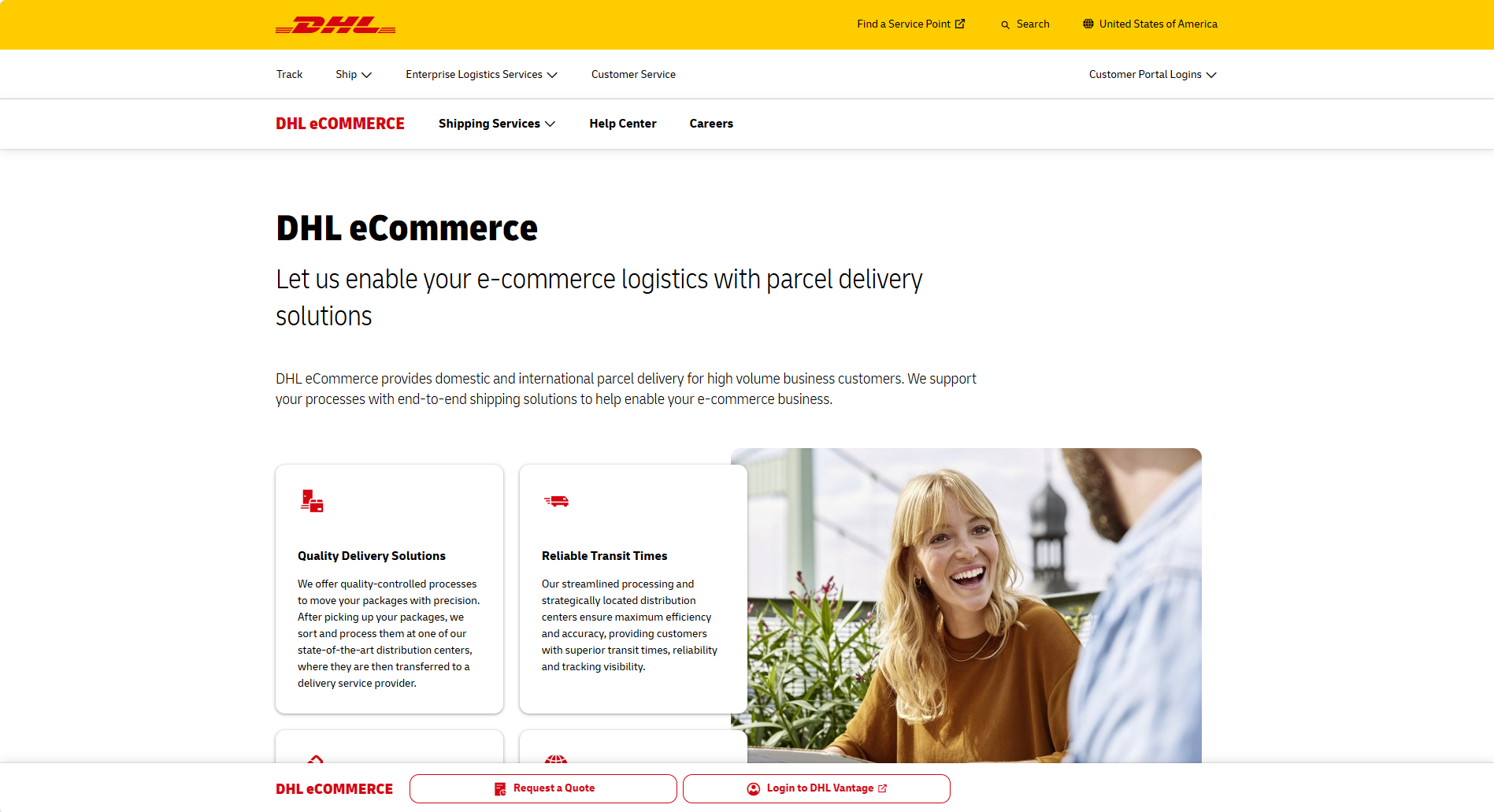
DHL eCommerce focuses on B2C online retailers shipping to shoppers across the U.S. It carries long-distance volume through its own 18 distribution centers before handing packages to a partner network for final delivery, extending its reach to about 170 million U.S. addresses.
Key features
- DHL Parcel for smaller items and DHL Parcel Plus for packages of up to 25 pounds
- A returns service built for online retailers
- Selective Routing and delivery confirmation options
- Carbon-offset shipping through the DHL GoGreen program
- 18 U.S. distribution centers feeding a final-mile partner network
- Reach to about 170 million U.S. addresses
Best suited for: B2C online retailers shipping smaller parcels nationwide who want one provider from pickup through final delivery.
What sets it apart
DHL eCommerce pairs its own long-haul network and distribution centers with a partner network for the final mile and builds carbon-offset options into its service through GoGreen.
Consideration
The final mile is completed by a partner network, and packages need to stay under about a cubic foot.
Quick comparison
|
Carrier |
Type |
Core strength |
Consideration |
|
OnTrac |
National carrier |
Coast-to-coast seven-day network with a low-surcharge economy tier |
Economy transit runs 1–2 days longer, contract only |
|
GOFO |
Last-mile carrier |
Two service tiers on a tech-driven network reaching 96 of the top 100 metros |
Faster Parcel tier caps at 20 lbs and 23.6 in |
|
UniUni |
On-demand last mile |
On-demand drivers that scale for peak, with three-photo proof of delivery |
Built for parcels under 10 lbs |
|
Amazon Shipping |
National network |
Parcel plus warehousing, fulfillment, and freight from one provider |
Recent offering; access through a console |
|
DoorDash |
On-demand local and returns |
Branded same-day local delivery and doorstep returns on a 7M-driver network |
Local and same-day; returns hand off to another carrier |
|
DHL |
National consolidator |
Own long-haul network plus a final-mile partner, with carbon-offset options |
Final mile via a partner network; ~1 cubic ft size cap |
How do you choose the right solution for your business?
There is no single best carrier, only the one that fits how you ship. The starting point is your own profile, and a few dimensions of it tend to decide the fit.
- Your package mix. The size and weight of what you send matters. Some carriers, and some service tiers, are built around small, lightweight parcels, while others handle a wider range into heavier weights. A catalog of small, light items points in a different direction than one full of bulky or heavy boxes.
- Distance. How far your packages travel shapes the cost. Short trips that stay within a region play to different strengths than long hauls that cross the country.
- Density. How tightly your destinations cluster is its own factor. Volume concentrated in a handful of areas is a very different profile than parcels scattered thinly across the map.
- Volume and timing. How much you ship, and how much that swings during peak season, affects which networks can absorb it smoothly and price it well.
- Speed and service. How quickly orders need to arrive, and whether you need extras like weekend delivery, same-day local delivery, or returns handling, narrows the field further.
Line up these pieces of your own operation against what each carrier does, and some will match your profile better than others. Many companies find that more than one carrier fits different parts of their shipping.
See what you could save with TransImpact
Your shipping data usually lives across carrier accounts, portals, and spreadsheets, which makes a full picture hard to assemble. TransImpact pulls it together, normalizes your charges across carriers, and shows where an alternative carrier would help and what the change is worth. If the numbers support a move, our Parcel Contract Negotiation team secures the right carrier contract tailored to how you ship.
Request a free analysis to see where your money is going and how to keep more of it.

Freight Invoice Audit
Validate every invoice against contracted rates, accessorial rules, and shipment details to identify errors before payment.

Automated Payment Processing
Streamline freight bill payment with automated workflows that ensure accuracy, timeliness, and proper approvals.

Multi-Mode Support
Audit and manage invoices across all transportation modes including parcel, LTL, FTL, ocean, air, and intermodal.

Claims Support
Capture the right data to support claims and disputes, improving recovery rates, and reducing time spent gathering information.

Spend Visibility and Reporting
Access dashboards and reporting that show total spend, cost drivers, trends, and areas of risk or opportunity.

Duplicate and Error Detection
Prevent duplicate payments and catch incorrect charges such as rate discrepancies, invalid fees, and billing inconsistencies.
Frequently Asked Questions
Any delivery company outside the largest national carriers, including regional carriers, last-mile specialists, on-demand driver networks, and consolidators. Many are built around online retail and run their own networks, technology, and service tiers.
Sometimes. It depends on your shipping pattern: where your packages go, what they weigh, and how much of that lines up with a given carrier's coverage and pricing. Comparing each option against your own shipping data is the way to know for sure.
Yes, and many companies do. A mix lets you send each package with the carrier that fits that order and gives you options when rates rise or capacity tightens during peak season. It works best when you set clear rules for which carrier handles which shipments.
Look at your package mix, where your orders go, how much you ship, and how fast they need to arrive, then line that up against each carrier's coverage, service tiers, and pricing. A rate analysis does this against your own data, order by order.