 Sales :
  Email :
You Paid For Perfect Delivery. Your Carriers Didn’t Deliver.
Stop Leaking Margin.
Start Paying Only What You Actually Owe.
Most shippers overpay by 3-7% on every freight invoice - not because rates are wrong, but because errors hide in plain sight. Duplicate charges. Misapplied accessorials. Out-of-contract fees. Our AI-powered freight audit catches what manual reviews miss, automatically validating every invoice against your contracts before payment is released.
Key Takeaways
- Refund recovery is only the starting point. The solutions that deliver lasting results turn audit findings into an ongoing system for controlling costs.
- The biggest differences between solutions come down to scope (parcel only, or parcel plus freight and planning), delivery model (self-serve software or managed partnership), and pricing (contingency, subscription, or custom enterprise).
- TransImpact is the only one of the eight that pairs parcel and freight audit with a dedicated demand-forecasting and inventory-optimization suite, and its parcel contract negotiation is delivered by a managed team rather than through self-service tools.
- Match the solution to your team's capacity, carrier mix, and pricing preference rather than a feature checklist.
Parcel spend management is the practice of tracking, auditing, negotiating, and reducing everything you pay to ship — across carriers, and increasingly across freight too. Doing it well takes more than a monthly invoice audit. The solutions that make a lasting difference help you understand what you pay, catch errors as they happen, and change the terms and routes that drive your costs in the first place.
This guide compares eight solutions that help businesses do exactly that. Some focus on parcel audit. Others reach freight, contract negotiation, supply chain planning, and hands-on consulting. Below you'll find what each one does well, where it fits, and how to match the right approach to your team.
How do you evaluate a parcel spend management solution?
Start with what the software helps your team do with shipping data, and how much of your cost picture it can reach. Some tools mainly store and report on the past. Others act on the data — catching problems, recommending fixes, and connecting shipping decisions to the rest of your operation. While some solutions offer full carrier negotiation, others work on a self-service model.
As you compare options, weigh a few things:
- Scope. Does the solution cover parcel only, or parcel and freight too — and can it connect those decisions to planning, like demand forecasting and inventory?
- Contract negotiation. Does the service negotiate carrier contracts with you, or only give you tools to do it yourself? A team that negotiates with you matters most at renewal or when you lack in-house expertise, and it's often where the largest savings are won.
- Continuous monitoring. Does the solution surface issues and savings as they appear, or do you have to dig through reports to find them?
- Clear recommendations. Do you get specific actions you can take, or dashboards you must interpret?
- Carrier and contract intelligence. Can you see carrier performance, surcharge trends, and how your contract terms play out across your network?
- Ease of use. Can your team reach meaningful answers quickly, without a custom reporting project each time?
The real test is how well a solution turns shipping data into actionable decisions.
The solutions and services compared
1. TransImpact
Website: transimpact.com
Overview
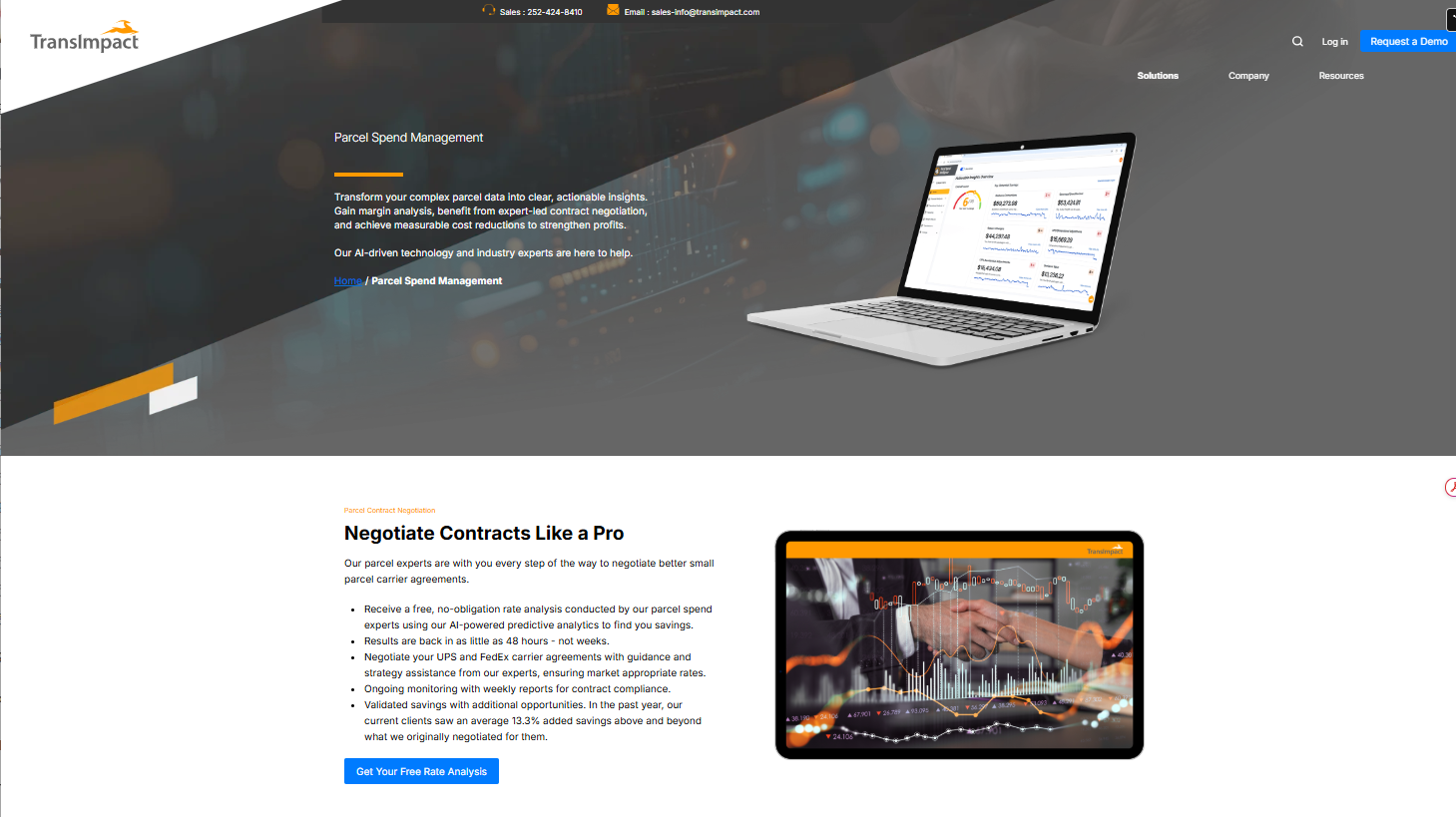
TransImpact is an intelligent transportation & supply chain solutions company. Its Parcel Spend Intelligence software audits invoices, recovers refunds, tracks carrier performance, and models contract scenarios. Freight Audit & Pay applies the same discipline to freight, and Supply Chain Planning connects shipping decisions to demand forecasting and inventory. Parcel contract negotiation services support reconciling contract terms and negotiating carrier rates. Within Parcel Spend Intelligence, its AI agent, Bolt, answers questions about parcel data and surfaces cost patterns and anomalies.
Key features
- Catch billing errors across every shipment and recover every dollar you're owed. Ongoing audit and recovery reduce parcel costs by 3–5%.
- AI contract modeling mirrors how carriers price your specific shipping profile, built on your own package DNA rather than industry averages.
- The Bolt AI agent delivers answers tied to your shipping data, with clear next steps you can act on today rather than charts to interpret on your own.
- Connect parcel audit, freight audit, and demand forecasting so a decision made in one area informs the others.
Ideal for: Businesses that want to control parcel and freight costs in one place, with the option to connect those decisions to broader supply chain planning.
What sets it apart
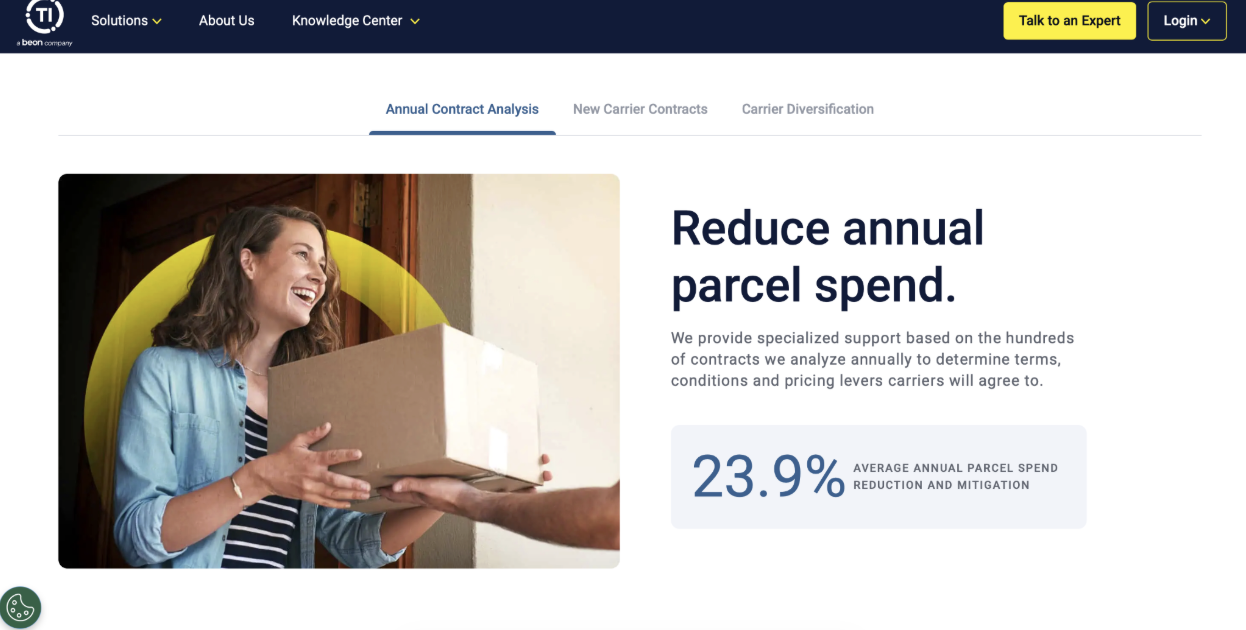
TransImpact lets you know exactly how much cost you can remove before negotiations begin, with savings guaranteed — if TransImpact doesn't deliver, you don't pay. Your negotiation is handled by a team who know how carriers decide what gets approved, where they have flexibility, and how to move deals through approval, rather than a self-service dashboard you work through alone. Clients have historically averaged 23.6% in annual net parcel contract savings, generating more than $2 billion in realized savings.
Consideration
Spans parcel, freight, and planning, so teams wanting only basic refund recovery may not use every service.
2. Reveel
Website: reveelgroup.com
Overview
Reveel's solution tracks carrier invoices, contracts, rates, surcharges, and performance to flag items that need attention. It aims to reduce dependency on outside consultants to interpret the data.
Key features
- Reveel's Parcel Spend Management 2.0 technology
- Automated invoice auditing and credit recovery across parcel carriers
- Analytics that compare you against similar businesses
- Contract modeling and simulation tools
- Multi-modal freight audit and payment via All Modes
- AI-powered anomaly detection for cost outliers
Ideal for: Businesses that want parcel analytics and contract modeling without depending on consultants.
What sets it apart
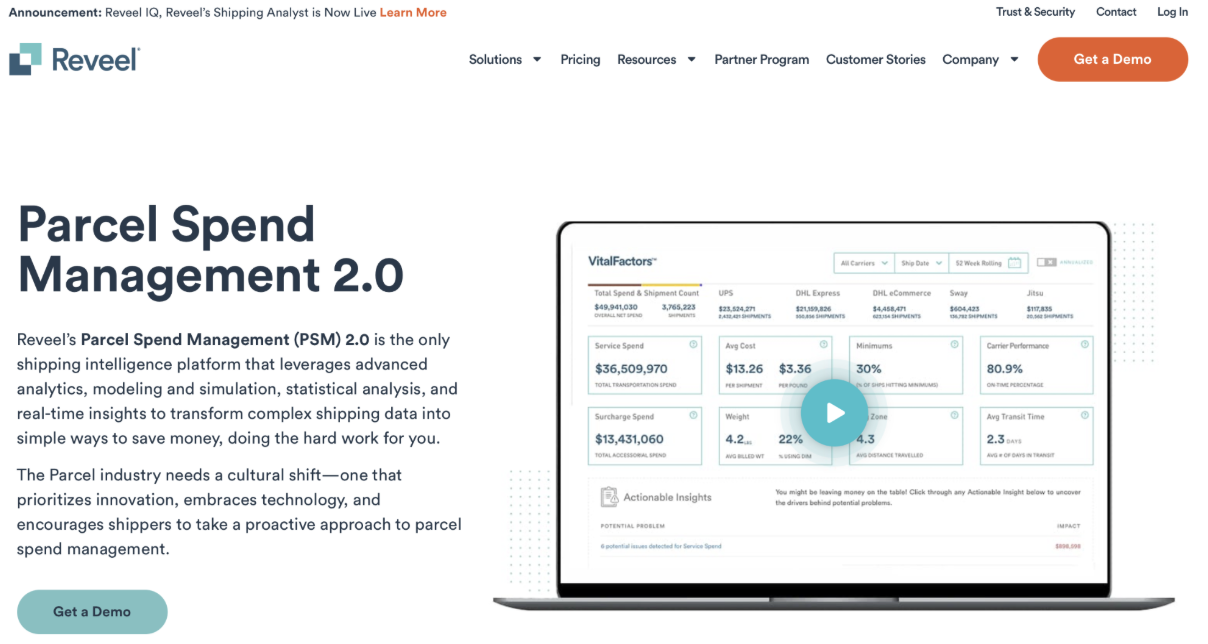
Reveel's Vital Factors Dashboard tracks eight performance areas, including service and surcharge costs, average cost per shipment, minimum charges, weight, zone, carrier performance, and time in transit, with a recommended action for each.
Consideration
Teams that also need demand forecasting or inventory planning may want a broader solution. Parcel contract negotiation is self-service.
3. Shipware
Website: shipware.com
Overview
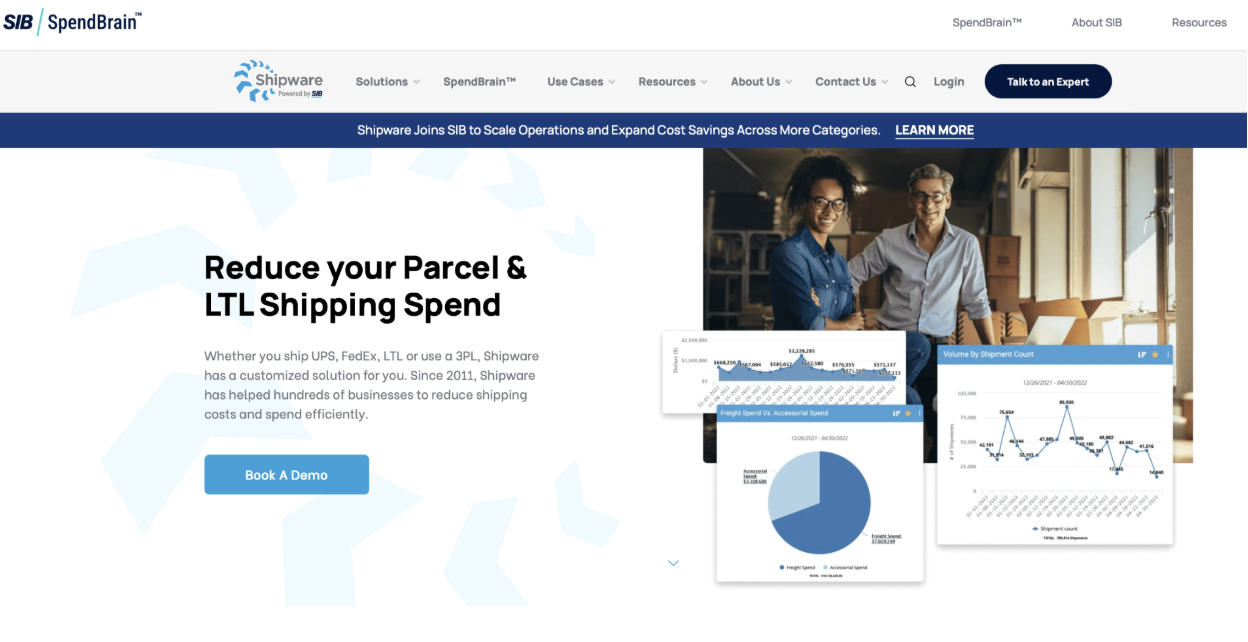
Shipware pairs automated invoice auditing with hands-on carrier negotiation, staffed by former UPS, FedEx, and LTL pricing analysts. Its contingency model means no out-of-pocket cost until savings are identified, and it works with businesses of all sizes: from smaller operations to the largest enterprises. Since its 2021 acquisition by SIB Fixed Cost Reduction, Shipware operates within SIB's broader SpendBrain platform, which covers expense categories beyond shipping.
Key features
- Parcel and LTL audit with automated refund recovery
- Access to the SpendBrain platform for cost work beyond shipping
- Carrier contract negotiation by former carrier pricing analysts
- Lost and damaged claims management
- Analytics and comparison dashboards
Ideal for: Businesses that want a consulting-led approach to negotiation and audit, with insider expertise and a straightforward contingency price.
What sets it apart
Shipware runs as a consulting engagement rather than a platform you operate — its team handles the audit and negotiation for you, priced on contingency, so its fee is tied to the savings it finds.
Consideration
A consulting-led model scales differently from a technology-first platform. Teams that want autonomous monitoring or self-serve scenario modeling may find those areas lighter here.
4. Intelligent Audit
Website: intelligentaudit.com
Overview
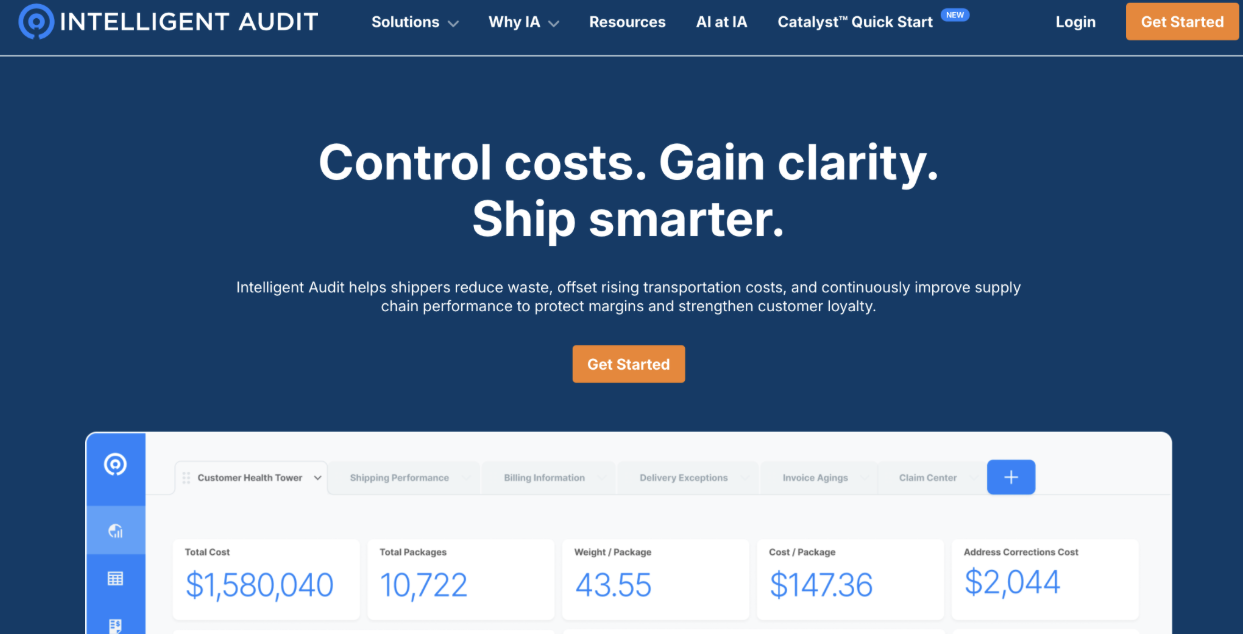
Intelligent Audit reports that it processes billions of shipments a year for many of the largest companies in the country, and it is known for the depth of its machine-learning anomaly detection, DeepDetectAI. It catches billing errors, fraud patterns, and operational risks that rule-based audit systems miss.
Key features
- DeepDetectAI machine-learning anomaly detection
- Multi-modal audit covering freight and parcel
- SKU- and store-level supply chain cost analysis
- Business intelligence dashboards with custom reporting
- Invoice validation, reconciliation, and carrier payment services
- Compliance monitoring
- A program aimed at mid-market businesses
Ideal for: Large organizations that need enterprise-grade freight and parcel audit with sophisticated anomaly detection and compliance workflows.
What sets it apart
Intelligent Audit handles very high shipment volume while keeping shipment-level accuracy, making it a strong fit for enterprises with complex transportation networks.
Consideration
Its core is multi-modal freight audit. Teams focused specifically on parcel modeling or continuous monitoring may need different priorities.
5. Green Mountain
Website: greenmt.com
Overview
Green Mountain serves some of the largest, most complex parcel networks in North America. It combines proprietary technology with an ongoing advisory relationship, working as a long-term extension of your team through network modeling, data transformation, continuous optimization, and carrier strategy. It works as a hands-on, managed engagement.
Key features
- Parcel and LTL cost-management solutions
- Proprietary technology with data transformation and normalization
- Continuous network optimization and carrier strategy
- Predictive modeling and decision support
- Carrier contract management and RFQ support
- Audit and invoice automation
- A long-term advisory engagement model
Ideal for: Large enterprises with complex parcel networks that want a technology-enabled advisory partner with continuous strategic engagement built in.
What sets it apart
Green Mountain positions itself as a strategic partner embedded alongside your team, handling network strategy as a long-term, ongoing advisory engagement. Its focus is enterprises running large, complex networks.
Consideration
The model is built for large, complex operations. Smaller teams, or those that want self-serve analytics and internal logistics capability, may want something different.
6. Sifted
Website: sifted.com
Overview
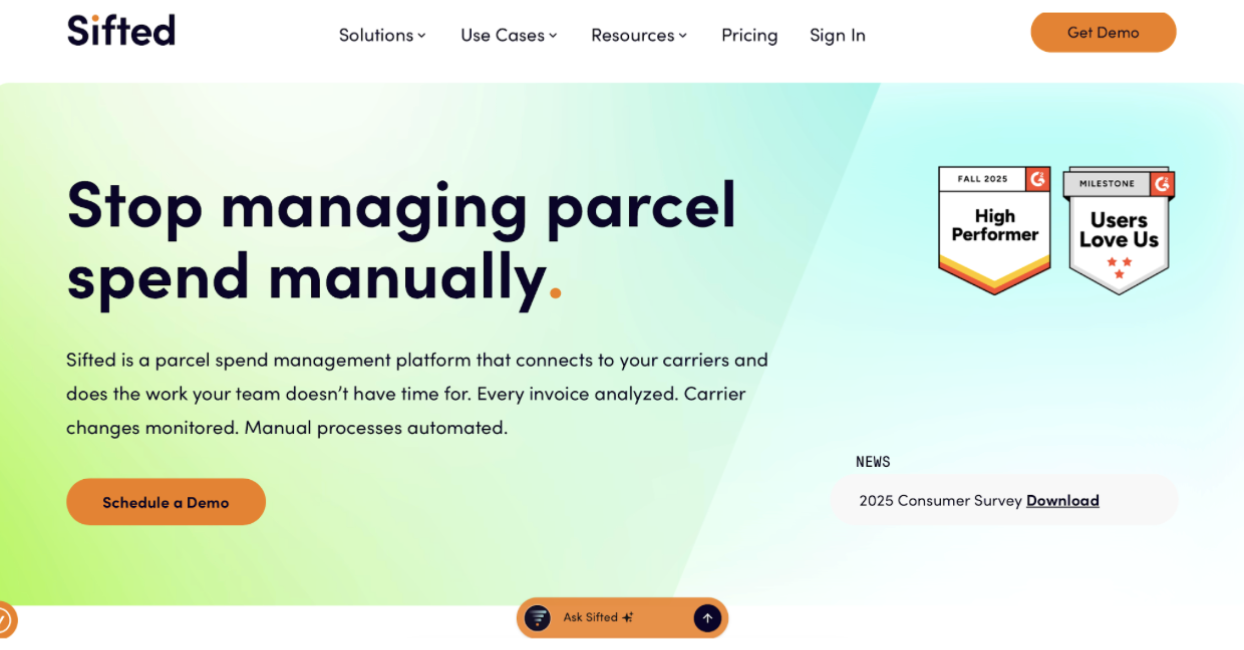
Sifted watches shipping costs, carrier performance, contract changes, and audit activity, then turns that into recommendations. Its software runs continuously in the background rather than on a schedule.
Key features
- SiftedAI Copilot, an agentic AI that monitors logistics continuously
- Configurable dashboards you can drill into for the KPIs that matter to you
- Automated parcel auditing and invoice analysis
- Real-time alerts and cost-reduction recommendations
- Carrier performance tracking and contract overview
- Scenario modeling for distribution center location, carrier diversification, service type, and DIM weight
- A parcel BI tool for advanced reporting and custom dashboards
Ideal for: Businesses that want AI-driven monitoring that keeps working between reviews.
What sets it apart
Sifted gives teams on-demand access to shipping analytics without a custom reporting effort, through its SiftedAI Copilot.
Consideration
Sifted concentrates on parcel. Teams that also need multi-modal freight audit or supply chain planning may want broader coverage. Its parcel contract negotiation service is self-service rather than managed.
7. Loop
Website: loop.com
Overview
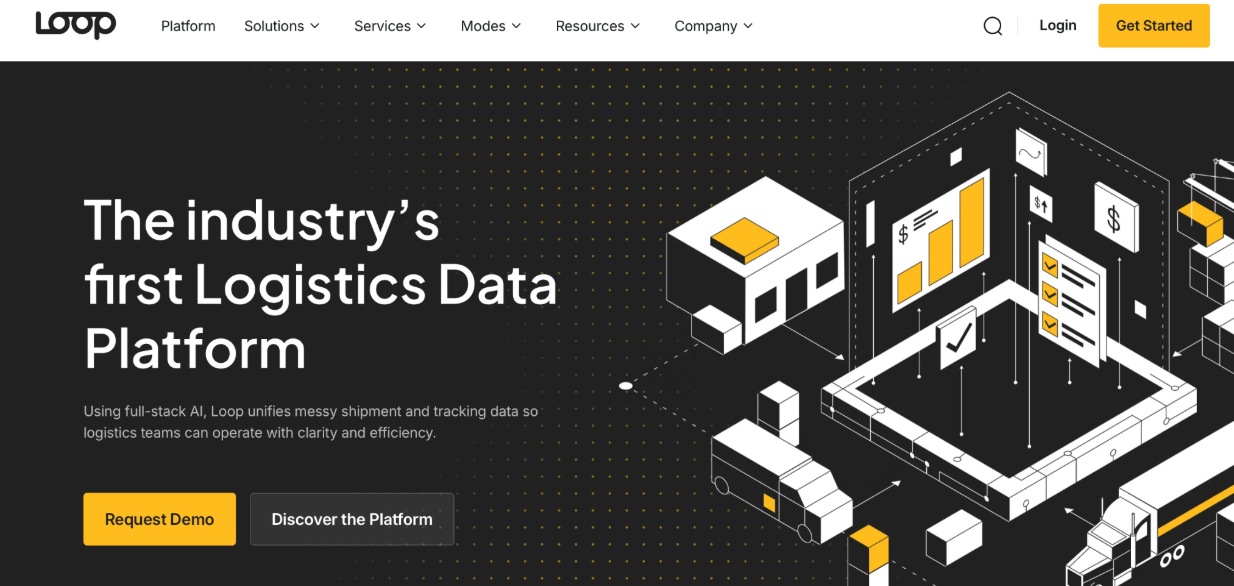
Loop is an AI-native audit and payment solution built to handle every mode in a single system. It ingests, standardizes, and audits shipping data regardless of carrier, document format, or source, giving finance and operations teams a unified view of transportation costs. Loop's DUX model powers its data foundation, and the company says it automates up to 99% of invoice processing without human touch.
Key features
- DUX 2.0 data engine for validated invoice data with automation
- Exception Agent for automated exception management and root-cause analysis
- Loop Intelligence AI Assistant for decision support across the logistics network
- Freight audit and payment across all modes, paired with parcel-specific audit and optimization
- GL coding, purchase order validation, and customs and tariff document review
Ideal for: Global businesses that want one AI-native platform spanning freight audit, parcel optimization, and broader supply chain data, and that value deep freight audit heritage alongside newer AI capabilities.
What sets it apart
Loop pairs more than 50 years of freight audit and payment heritage, gained through its Data2Logistics merger, with full-stack AI built to unify logistics data across modes and functions, from invoice audit to GL coding to customs review, in a single system.
Consideration
The 2025 combination of Loop with Data2Logistics and StrategIQ Commerce means the merged platform, pricing, and support model are still maturing. Businesses whose primary need is parcel-specific optimization may find a parcel-first solution more directly aligned with their goals. Moreover, its parcel contract negotiation is self-service.
8. Transportation Insight
Website: transportationinsight.com
Overview
Transportation Insight is a transportation management company that helps businesses reduce parcel and freight costs through analytics, consulting, and managed logistics services. Alongside parcel audit and optimization, it offers LTL, truckload, and broader supply chain services.
Key features
- Parcel invoice audit and payment management across carriers
- Carrier contract optimization with expert-guided analysis
- Carrier mix analysis and regional carrier diversification support
- Claims management, including filing, documentation, and follow-up
- Multi-modal capabilities spanning parcel, LTL, FTL, and drayage
Ideal for: Enterprise and large mid-market businesses that want a co-managed logistics partner rather than a self-service platform.
What sets it apart
Transportation Insight combines transportation technology with ongoing consulting and managed services, positioning itself as an extension of a customer's logistics team. Beyond parcel, it supports freight optimization across multiple transportation modes, which suits organizations with complex supply chains.
Consideration
A managed-services approach can be more involved than businesses looking for self-service software. Teams focused primarily on parcel optimization, rather than broader multi-modal transportation management, may find a specialized solution better aligned with their needs.
Quick comparison
|
Solution |
Ideal for |
Core strength |
Consideration |
|
TransImpact |
Controlling parcel and freight costs in one place |
Parcel and freight audit plus supply chain planning in one solution |
Broad scope may exceed teams wanting only basic refund recovery |
|
Reveel |
Parcel shipping intelligence |
Vital Factors Dashboard; multi-modal audit and payment |
Limited planning beyond parcel; self-service contract negotiation |
|
Shipware |
Consulting-led negotiation |
Carrier-insider expertise; contingency pricing |
Lighter on self-serve automation and modeling |
|
Intelligent Audit |
Enterprise freight audit |
DeepDetectAI anomaly detection; multi-modal coverage |
Freight-audit core; less parcel-specific focus |
|
Green Mountain |
Enterprise parcel strategy |
Technology-enabled managed services; long-term advisory |
Built for large, complex networks; less self-service |
|
Sifted |
Autonomous parcel optimization |
Continuous AI monitoring; agentic Copilot |
Parcel-focused, no multi-modal or planning; self-service contract negotiation |
|
Loop |
Global multi-modal audit and payment |
AI-native audit across all modes; DUX data engine |
Post-merger platform still maturing; self-service contract negotiation |
|
Transportation Insight |
Co-managed multi-modal logistics |
Technology plus consulting and managed services |
Managed model is more involved than self-serve software |
How do you choose the right solution for your business?
Start with scope. Refund recovery is table stakes; almost any audit tool recovers overcharges. If your goal is paying less in the first place, you need a solution that goes upstream into contract compliance, scenario modeling, and proactive alerts.
Decide between software and a service. Some of these are self-serve software solutions you operate — you get the analytics and modeling tools, and your team does the work, including negotiating your own carrier contracts. Others are service led: a team audits, negotiates, and manages the program for you. Contract negotiation is where that choice hits your costs hardest. A self-service tool can tell you what to ask for, but you're still negotiating against carriers who know your volumes and margins better than you do. A team that negotiates these contracts every day knows where the carriers have room to give, so more of the available savings tends to end up with you instead of left on the table.
Weigh carrier complexity. If you run multiple carriers or manage parcel alongside freight, confirm the solution handles that breadth. Gaps across carriers undercut the whole point of an audit.
Factor in pricing. Contingency, subscription, and custom enterprise pricing carry different risk profiles. Contingency removes upfront cost but usually applies only to recovery. Subscription pricing makes budgeting predictable and often unlocks broader capabilities.
The audit is the entry point. The solutions that pay off over time reach past it — into contract terms, carrier strategy, and, at their broadest, the freight and planning decisions that shape your costs before an invoice is ever cut.
See what you could save with TransImpact
Shipping data usually lives in carrier accounts, portals, and spreadsheets, making a full picture hard to assemble. Parcel Spend Intelligence pulls that data together, normalizes charges across carriers, and monitors your accounts so savings surface as they appear, with Bolt ready to answer questions about that data. TransImpact's parcel contract negotiation services use AI contract modeling plus 1,000+ years of carrier experience to tell you exactly what rates you should be paying.
Request a free analysis to see where your money is going and how to keep more of it.

Freight Invoice Audit
Validate every invoice against contracted rates, accessorial rules, and shipment details to identify errors before payment.

Automated Payment Processing
Streamline freight bill payment with automated workflows that ensure accuracy, timeliness, and proper approvals.

Multi-Mode Support
Audit and manage invoices across all transportation modes including parcel, LTL, FTL, ocean, air, and intermodal.

Claims Support
Capture the right data to support claims and disputes, improving recovery rates, and reducing time spent gathering information.

Spend Visibility and Reporting
Access dashboards and reporting that show total spend, cost drivers, trends, and areas of risk or opportunity.

Duplicate and Error Detection
Prevent duplicate payments and catch incorrect charges such as rate discrepancies, invalid fees, and billing inconsistencies.
Frequently Asked Questions
Parcel spend management is the practice of tracking, auditing, negotiating, and reducing everything you pay to ship parcels across your carriers. It covers invoice auditing and refund recovery, carrier contract negotiation, carrier performance, and ongoing cost reduction. Software helps you cut shipping costs, recover carrier refunds, and understand your logistics performance, and the strongest solutions go past refund recovery to contract monitoring, scenario modeling, proactive alerts, and carrier contract negotiation.
Parcel auditing reviews invoices to catch billing errors and recover refunds. Parcel spend management is broader: it includes auditing and adds contract work, network analysis, and ongoing cost reduction.
Savings depend on your carrier mix, volume, and the favorability of your current contracts. Invoice auditing recovers a modest amount through refunds, while contract and network optimization usually account for larger reductions. The answer is that it varies, which is why most solutions run an analysis on your own data before quoting a number.
Negotiation sets your rates; these solutions verify that those rates show up on your invoices, catch accessorial and surcharge fees between negotiations, and model whether your terms still fit as your volume changes. Parcel spend management also includes parcel contract negotiation, ensuring you pay the rate you should be paying.
Most begin with read-only access to your carrier accounts or a set of recent invoices — FedEx, UPS, and any regional or LTL carriers you use. From there, the software normalizes your charges and runs an initial analysis, often before you commit to anything.
Carrier portals show what a single carrier billed you. A parcel spend management solution pulls data from all your carriers into one place, checks each charge against your negotiated rates, and flags billing errors and overcharges that a carrier's own reporting does not surface.